Micheál Jacob is a writer, producer and script editor who has worked on many highly successful comedy shows such as Birds of a Feather, Goodnight Sweetheart, Two Pints of Lager and a Packet of Crisps, The Smoking Room, and My Family amongst many others.
How did we meet? That’s the sort of question which has been answered in the pages of glossy supplements for years now. I met Micheál across a crowded office. The Music and Arts department at BBC Scotland circa 1989. We had both been hired as Assistant Producers.
Micheál had relocated from London. While I had moved up one floor from General Features. I was twenty-something. Micheál was whatever age he was. Older. He wore a jacket, shirt and trousers. It would be rather strange if he hadn’t been wearing trousers. I hadn’t as yet evolved into wearing a suit so was probably the same. We connected because we both smoked cigarettes, liked drinking wine, and shared similar tastes in books, music, and film. I was in an on-again, off-again relationship with a beautiful and talented woman. Micheál was recovering from a folie a deux with an unobtainable dream. He was a gourmand while I was a barfly who spent too much of my spare time in the long day’s journey into a pint.
We are both of Irish descent. Micheal closer than me. We discussed the novels we weren’t going to write and searched for the perfect opening sentence. Declamatory like Auster? Or clever like Joyce? We often found ourselves in the Ubiquitous Chip sometimes in the company of brilliant writers like William McIlvanney and Peter McDougall as we danced in conversation around Morag Fullerton’s handbag. These were good times but my friendship with Micheál didn’t really take-off until he left BBC Scotland and returned to London. We wrote long A4 letters to each other about nothing in particular but everything all at once. Reports from the front wherever we thought the battle may be. By then Micheál was working as a script editor on Birds of a Feather which as any fule kno, is just one of the many classic series written by the brilliant writing partnership of Laurence Marks and Maurice Gran.
As you will find out later, Micheál, Laurence and Maurice had once been in a band together which almost made it. Well almost. This was before Lo and Mo earned their stripes writing comedy routines and sketches for Frankie Howerd, then went onto achieve tremendous success with Holding the Fort, Shine on Harvey Moon, Birds of a Feather, The New Statesman and Goodnight Sweetheart.
Micheál script edited a couple of those series before he served as Creative Head of Mainstream Comedy at the BBC. Now he produces one-woman shows for a friend in Manchester, does some consulting, some teaching, some writing, some editing and a bit of development here and there. He also co-created and produced an online audio sitcom, and has script edited nearly 40 dramas for BBC Radio 4 and Radio 3.
To put it simply, Micheál is an all-round good guy.
In 2024, Micheál performed his one-man stage show Life in Progress as part of the Manchester Fringe. What follows is an extract from this highly acclaimed show.
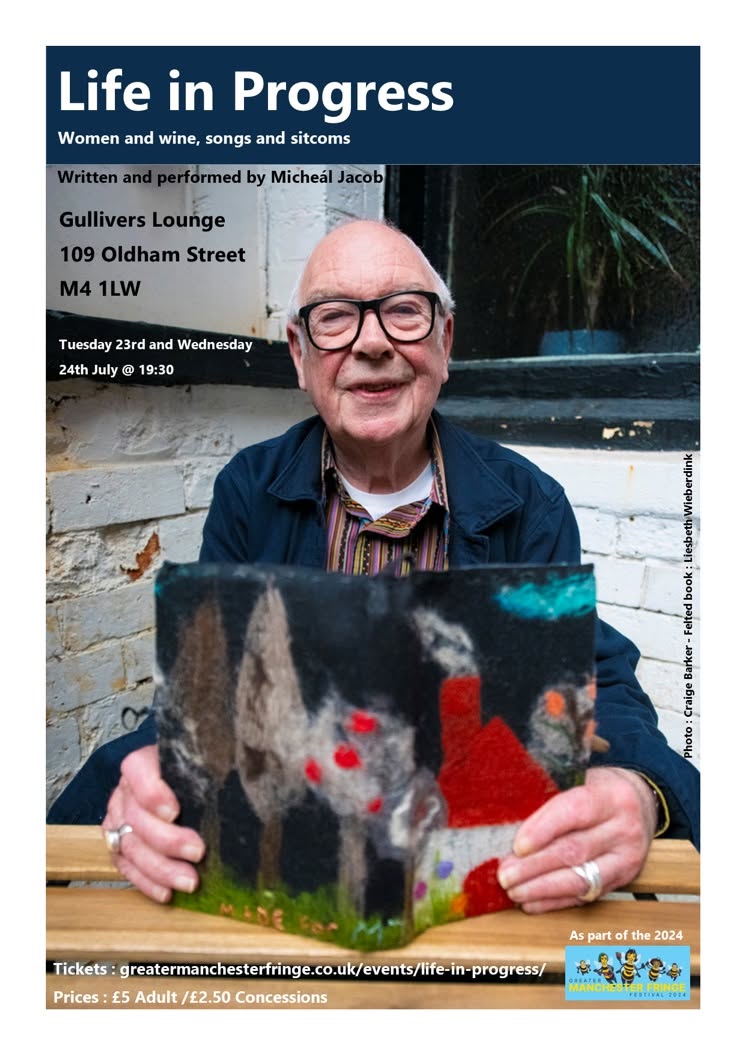
LIFE IN PROGRESS
Women and wine, songs and sitcoms
When I work on a script out in Didsbury/It’s always a very good week/Makes me think of my friends back in TV, and the others of whom I won’t speak/How I used to wander on a Sunday, and my wages on Beaujolais spend/And then I would lie until Monday. with my red-headed Kate in Crouch End
May the ghost of Dominic Behan forgive me for adapting his song…
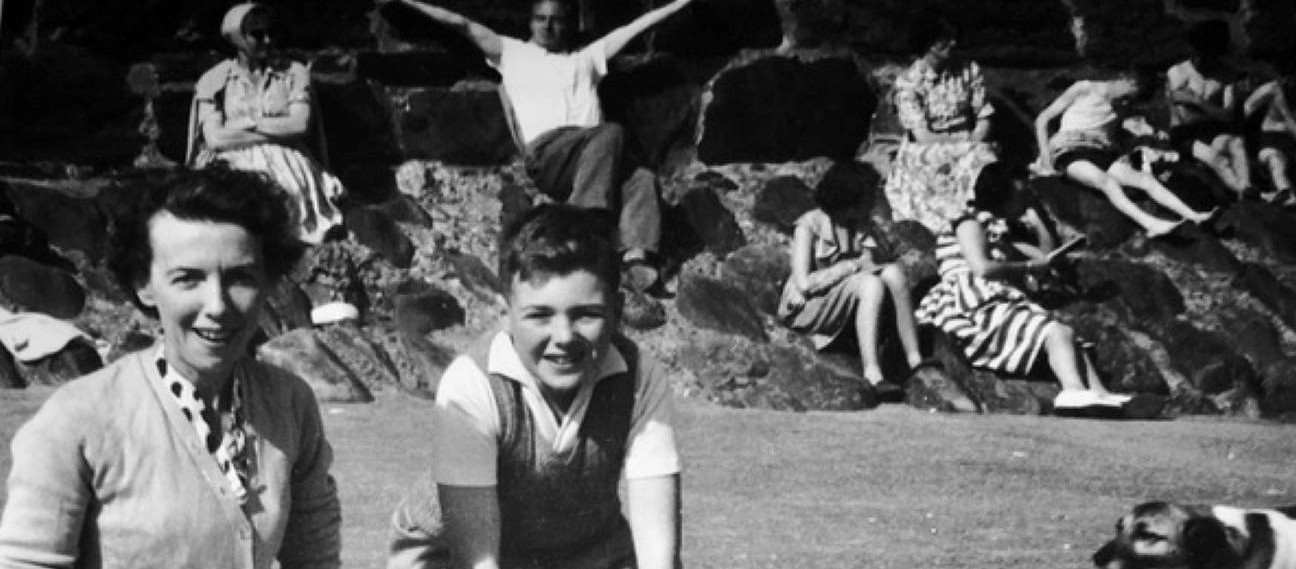
Once upon a time, say 1890, there was an accountant in Belfast called Billy Long. He had a young wife who died tragically, he went to Douglas in the Isle of Man for a holiday to cheer himself up, met a Lancashire Lass called Alice Aldred, they fell in love and got married.
A new wife inspired a fresh start, so Billy took Alice to Waterford in the south of Ireland where he got a job as chief accountant in a department store on the quayside, and they had a family of three girls.
The first was Nell, the glamorous one, who sang and danced in end of the pier shows. The second was Bunty, who was the sensible one.
Then later on there was Wendy, who Alice didn’t really want and who gave her postnatal depression. Which wasn’t a thing in 1920. Alice took to her bed, and Wendy was sent to cousins in Cheadle, for reasons she didn’t understand. The girls grew up and the family moved to a seaside village with a three-mile beach called Tramore, which in Irish means ‘big strand.
Their house was called Arcadia. Nell met a brewery manager from Somerset, had fun in the sand dunes, got pregnant, got married and moved to England where she had two more children, then moved back with them to Arcadia, saying that her husband was an abusive alcoholic.
Bunty met a dashing sales rep with a fast car who swept her off her feet. They got married, and the dashing sales rep handed back the car, abandoned work, and never had a job again. They rented a bungalow three minutes away from Arcadia, where Bunty spent the rest of her
long life.
As soon as Wendy left school she did a catering course in Dublin, got a job in a big house in Galway as a cook, and joined the British army when war broke out. Tramore wasn’t where she wanted to be. She worked her way up to being a Captain.
Then she met an older Major called Mark Jacobs. They bonded over The Times crossword in the officers’ mess, and when the war was over they got married. The major was a jolly Jew who loved the music hall – particularly Max Miller and Flanagan and Allen – and whose family owned and drove black cabs. Instead of getting the sort of job a major might get, he was happy driving a cab and going to the music hall. Which of course meant irregular hours. Which is why, when Wendy was going through his drawers and found a cache of letters from another woman with whom he had a family in Edgware, the irregular hours made sense.
So Wendy, like Nell, went back to Arcadia, discovered she was pregnant, and that’s where my once upon a time begins. Naturally I don’t remember the event, which was the week before Christmas. It was the coldest winter on record and I couldn’t be taken outside until February. Which perhaps explains why, when I encountered central heating for the first time many years later in Glasgow, I burst into tears.
Grandad Billy had died during the war, and Grandmother Alice had become a semi-recluse, spending most of the time in her room. She was a spectral presence, and one of my first memories is being told: “Ssh – granny.” Then one day I didn’t need to shush because granny died and I wasn’t allowed to go to the funeral.
So there we are, Aunty Bunty married to my deadbeat Uncle Sidney, a loud man who never got up before ten o’clock; Aunty Nell with a fatherless family and no visible means of support; and Wendy, my mum, who was a single mother at a time in Ireland where single mothers weren’t viewed very favourably. If we had been Catholics, who knows where she might have ended up and whether I might be here at all? But we were Protestants. And the story was that my father had died in the war. I was an only child in a world of women who loved me unreservedly.
When I was four, my mum got a secretarial job in Waterford with an older man who had an invalid wife. She would come home smelling of Lily of the Valley, cigarettes and gin to kiss me goodnight. Wendy and older men… It wasn’t a very sociable life, probably because we were too hard up to entertain visitors, so we didn’t have any. We had credit at the shops in the village, which was sometimes a bit embarrassing. There were discussions about whether or not there was enough money to light a fire. There were icicles inside my bedroom window. And there was a memorable night when Mum and Aunty Nell were very down and really fancied a drink. Which meant Mum going to Robinson’s bar,
poking her head round the door, Mary Robinson coming to see what she wanted, then mum waiting outside for a brown paper bag, bearing it home and splitting a bottle of Guinness with my aunt.
When I was ten, my mother thought I should go to boarding school to escape from the all-female influence and experience a manly life.
It felt like a betrayal, being thrown into a world for which I wasn’t at all equipped – big scary boys, big scary masters, a big scary building which was an architectural masterpiece and as far from central heating as you could get. It was called The King’s Hospital, known as KH, and a long way from Arcadia.
The Headmaster was past retirement age and straight out of Dickens. He loved beating boys who stepped out of line and making them cry. His evil sister, the Matron, didn’t believe in illness. She was also in charge of the catering. Even now I can’t face shepherds pie, which involved a week’s assorted leftovers with burnt mashed potato on top. It was a school mainly attended by farmers’ sons, so I became rather an expert on combine harvesters. In the farming context, I was a bit exotic and, strangely, a pretty boy. The English teacher encouraged my writing, allowed me to go to the theatre and films, and fiddled with my ear in class. The French teacher was friendly and loaned me books. The master in charge of cricket realised I was crap at sport and made me scorer of the junior team, which meant trips out, and nice teas.
The music teacher, who oddly wasn’t gay, liked my voice and put me in the choir. There were boys who weren’t scary and became friends. And then, when I was 14, my mum met the third of the four older men in her life, got a job with him in London as the Sixties were beginning to swing, and from priest-ridden, history-addled Ireland I was transported to the centre of the world, at least during the
holidays. London was a place where to find accommodation you looked at small ads in the evening papers and newsagents’ windows, and these ads said, in varying orders, No Blacks, No Irish, No Jews, No Dogs. So mum dropped the ’S’ off Jacobs because there were Quakers in Waterford called Jacob
who made biscuits.
But that didn’t stop us being proud of being Irish. A semi-local folk group, The Clancy Brothers and Tommy Makem, made a success in America, which was wonderful. An architect from County Tipperary, Sean Kenny, revolutionised theatre design with Oliver. And then were was our own local hero Val Doonican, who brought Waterford to the world. And contributed greatly to the knitting industry. I’m not sure this song is entirely suitable for nowadays, but:
(Sings Agricultural Irish Girl)
Oh she’s a fine big lump of an agricultural Irish girl
She neither paints nor powders and her figure is all her own
But she can hit that hard – ow! – you’d think was a kick of a mule you’d got
The fill of your arms of Irish love is Mary-Ann Malone…
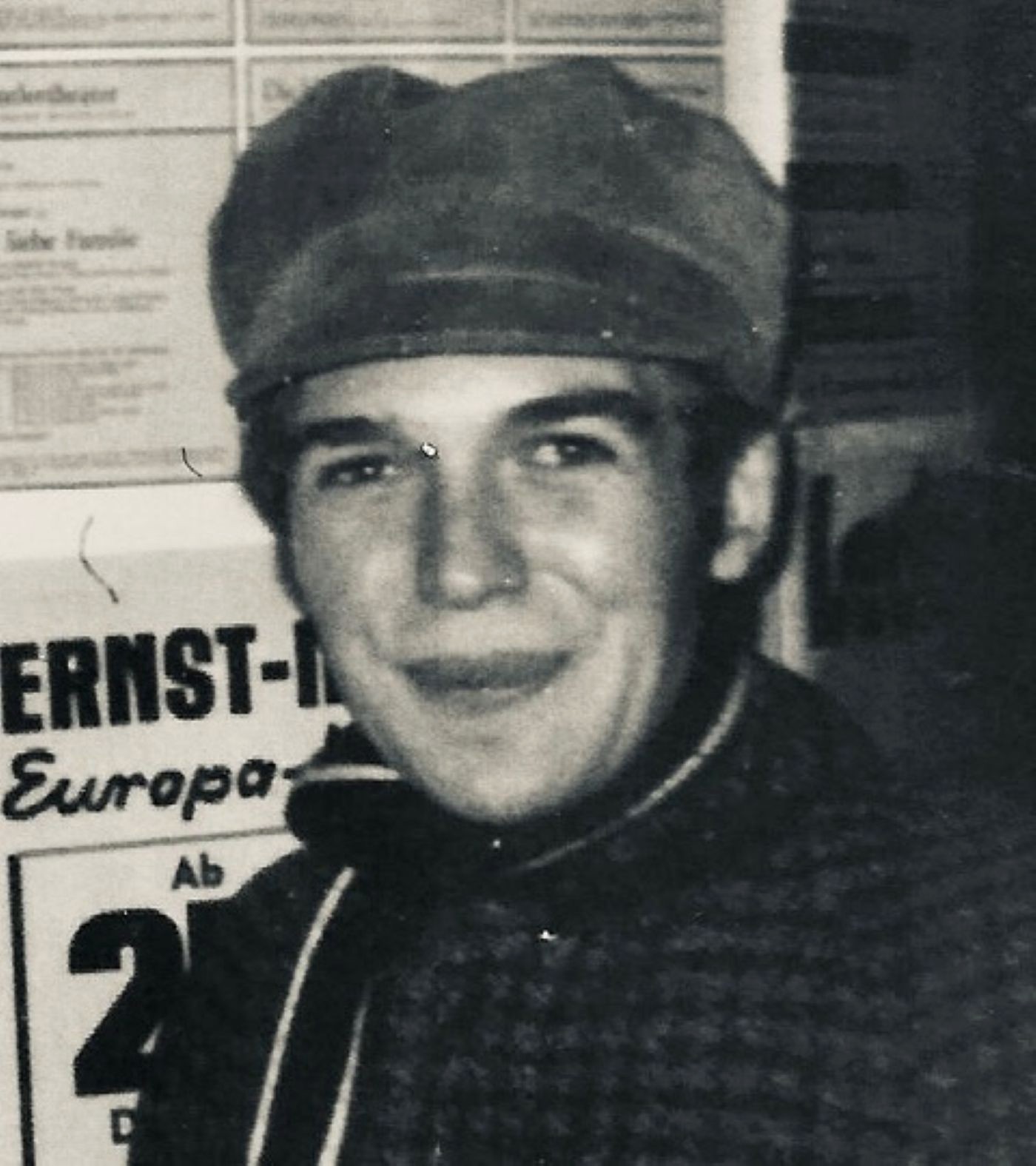
I still keep my first passport, with its stiff covers, that I got when I was fourteen. That was the age when I started to think about what I wanted to do with my life, and it was certainly the age when I started thinking about naked women. Quite a lot. I wouldn’t have known what to do with a naked woman if one had suddenly appeared, but I had an idea it might be fun to find out. Later on, my mother said she had considered walking around naked when I was little so as to remove the mystery, but I’m rather pleased that she didn’t. I have enough neuroses as it is.
It was a strange period of life – it felt as if I was in a waiting room, uncertain when the door to the inner sanctum would open. In retrospect, my Dickensian school took considerable steps to hire maids and domestic staff who would never awaken a young man’s fancy, and just in case dressed them in shapeless overalls and forbade make-up.
One day, there was a new recruit who, even without make-up, caused something of a stir. Unlike the other maids, who were country girls, this one came from Dublin and had a rather street-wise air. She was also prepared to chat when the matron wasn’t looking, and she seemed to take a shine to my friend Doug and me. Perhaps we just amused her.
One night Doug and I were in the infirmary, both suffering from flu and feeling pretty miserable, when the magic maid appeared. She was wearing street clothes, and perfume, and make-up – it was like a fever dream. She said she had come to say goodbye. She was sneaking off to catch the night boat to Liverpool to meet a man she had been writing to. She wanted to say goodbye because we had talked to her like a human rather than a skivvy, and she hoped that one day we’d be as happy as she was.
And then she disappeared, leaving behind a strong smell of perfume and a feeling that the waiting room door had opened a notch, and I had been granted a vision of what lay beyond, before the door was closed again.
Sadly, Doug is no longer with us, though we had kept in touch. When there was a gap between emails, one or other of us would begin the next one with – are you still alive? That’s how I began my last email to him. The reply came from his wife, to say that he wasn’t.
When I left school I got a job in a publisher’s post room, mainly packaging books, picking up or delivering manuscripts, and collecting the mail twice a day. The head of the post room was a Maltese man called Tony, who was a Junior Mister Universe, and used to sit on a roll of corrugated paper
popping supplements and flexing his biceps. He hadn’t really grown much since his junior days and was too small for the real thing, which weighed heavily on his mind. Then there was Martin and Mike.
At the end of my first week, when we had been given our pay envelopes, I discovered that the
tradition was to walk into Soho, go to a pub and have a pint, then go to a strip club. My reaction caused a great deal of hilarity. “But I’m seventeen,” I said. “Will they let me in?” They said there would be no problem and there wasn’t. So there I was, in a small dark room upstairs in Soho, full of men all looking rigidly ahead and not making eye contact, waiting for something to happen. There was a clatter of heels, the needle dropped on a record and a young woman appeared.
She gradually removed items of clothing, making artful use of a feather boa. And finally removed her g-string as the song ended and the lights simultaneously went out. The heels receded, the men stayed where they were, and my colleagues were very keen to know what I thought about my first naked woman. I said something equating to ‘phowar’, but my heart wasn’t really in it and remained
untouched when we left after the next few acts. It was all a bit disappointing really. I had expected … well, I’m not sure what I’d expected – some kind of thrill, some frisson, some sense of transgression. Instead it felt rather tawdry and sad and as far from erotic as you could get. I found an excuse not to go the next Friday night, and then the next Friday and then it was accepted that I wouldn’t be joining in.
Not long after, the personnel manager, Miss Thorp, called me in for a chat. She was quite a frightening woman whose passion was keeping younger staff members in line. She had sent my friend Jenny home because her skirt was too short. I wondered what I had done wrong. But she asked if I’d be interested in becoming a trainee publisher on their scheme? Some of the senior people thought I might have a future beyond the post room. It would mean moving to Glasgow. So I thought why not?
The company had an accommodation list from which I and the other two trainees – both public school English boys with whom I had very little in common – picked lodgings. When I went to see mine in the evening after work it was very dark and smelled of mould, was freezing cold, and the landlady was rather unsteady on her feet. She showed me the room, I said I’d take it, because I had nowhere else to go. She left, I moved over to the bed, kicked something that clinked, and discovered a large stash of empty gin bottles. The next day I explained the situation at work, they found me somewhere else, and that was when I forged my lifelong relationship with central heating.
It was in the summer that I set out on a night train to London for a week’s holiday with my mother. A night train seems a bit weird in retrospect – perhaps I’d done a day’s work and wanted to get away as soon as I could? In any case, I‘d settled myself down when a girl came and took the seat next to me in the compartment – there were compartments then rather than open plan, you could open the windows, you could smoke. Different times. As we rattled south and it got past midnight, just I and the girl were awake. We’d got on immediately and were chatting away. She said her name was Silé.
She had lots of silver rings, wore floaty clothes and a white mac stained with fake tan, and told me she was a poet. She was going to Cornwall for the summer to meet other poets and musicians to sleep on beaches and have a good time. I thought she was fascinating, and we were getting along well, so it wasn’t entirely a surprise when we stopped whispering and started kissing. Everyone else was asleep. I
hope. Silé sat on my knee. What happened next was rather more of a surprise, something of a shock and for me a unique experience. Though for obvious reasons Silé kept most of her clothes on. Not quite my 14-year-old dream. Probably better. We wrote letters, because that’s what you did in the 60s. She sent me poems. I’ll always remember one thing she wrote – “I want to be thin, and pure, and kind. To everyone.” When she got back to Glasgow she said it had been a wonderful summer and now she was going back for her final year. We saw one another a bit, but it all fizzled out when normality kicked in. How can you repeat the magic of a brief encounter on a train?
But naked women were the just one of three things on my mind when I was fourteen, because I decided I was going to become a pop star. All it seemed to need was the ability to sing which I could – and a guitar.
So I asked my mum if she would buy me one. Knowing very well that I wasn’t great at perseverance if things didn’t come easy, she said she would buy me a ukulele, and if I learned to play that, she would get me a guitar. Somehow the ukulele doesn’t lend itself to rock and roll – it’s hard to strike rock god
poses with a little instrument – but rather to my surprise, as well as my mother’s, I mastered it quite quickly. So I was able to go to Charing Cross Road with some money in my fist and come home with a guitar. It was so exciting. I formed a band at school, which I think was probably crap. One of the others had a very expensive electric guitar with a tremolo arm, but he was rubbish. We had a falling out over his ability to keep time, and then a massive falling out when he played the female lead in a play that I wrote and directed – in a boys’ school we had to take a Shakespearean approach to casting. He could never remember his lines, didn’t take notes very well, and I ended up playing the part myself in a blonde wig, what I realise now was a rather brief miniskirt, and lots of tissue paper in a bra. For the term after that I was known as ‘legs’.
Being in London and not yet having any friends, I had a lot of time to occupy, so I took to hanging out in folk clubs. When I began, like nearly every young male folkie at the time, I wanted to be Bob Dylan rather than Val Doonican. I wrote very meaningful songs, that were either about why I’d been dumped, or why the girl I liked didn’t seem interested. Lots of pain! They were the sort of nights where a couple of people had been booked – and how we envied them getting their five quid at the end of the evening – and the rest of us got three numbers to see if we’d get the nod for a booking next week. Weirdly, despite being a genius, it never happened, so I teamed up with a new friend Andy to see if a duo might do better.
He had a rich family and thus owned a Mini, which was very cool. The problem was that he was brilliant when we were rehearsing but had crippling stage fright in front of an audience. Though probably the bigger problem was that we were both big fans of Leonard Cohen, and we named ourselves after one of his novels – The Beautiful Losers. Sort of a death wish really. Plus he did a lot of acid, and had a very bad trip on the night that a friend needed support after having had a much older lover die in her bed. Andy and I were meant to be cheering her up, but he was having a bad trip, so we ended up looking after him, while he demanded to play a miserable Neil Young song over and over again. I feel helpless, helpless, helpless A fun night!
After that we parted musical company, so after being a single performer, then a duo, logically the next step was a trio. There was a Mod bass player where I worked, and his cousin played drums, so we thought we’d do some practising and see where it went. The cousin was actually a really shit drummer, but he had a car that would fit his drums and the gear, so basically he was in. The bass player was called Laurence Marks.
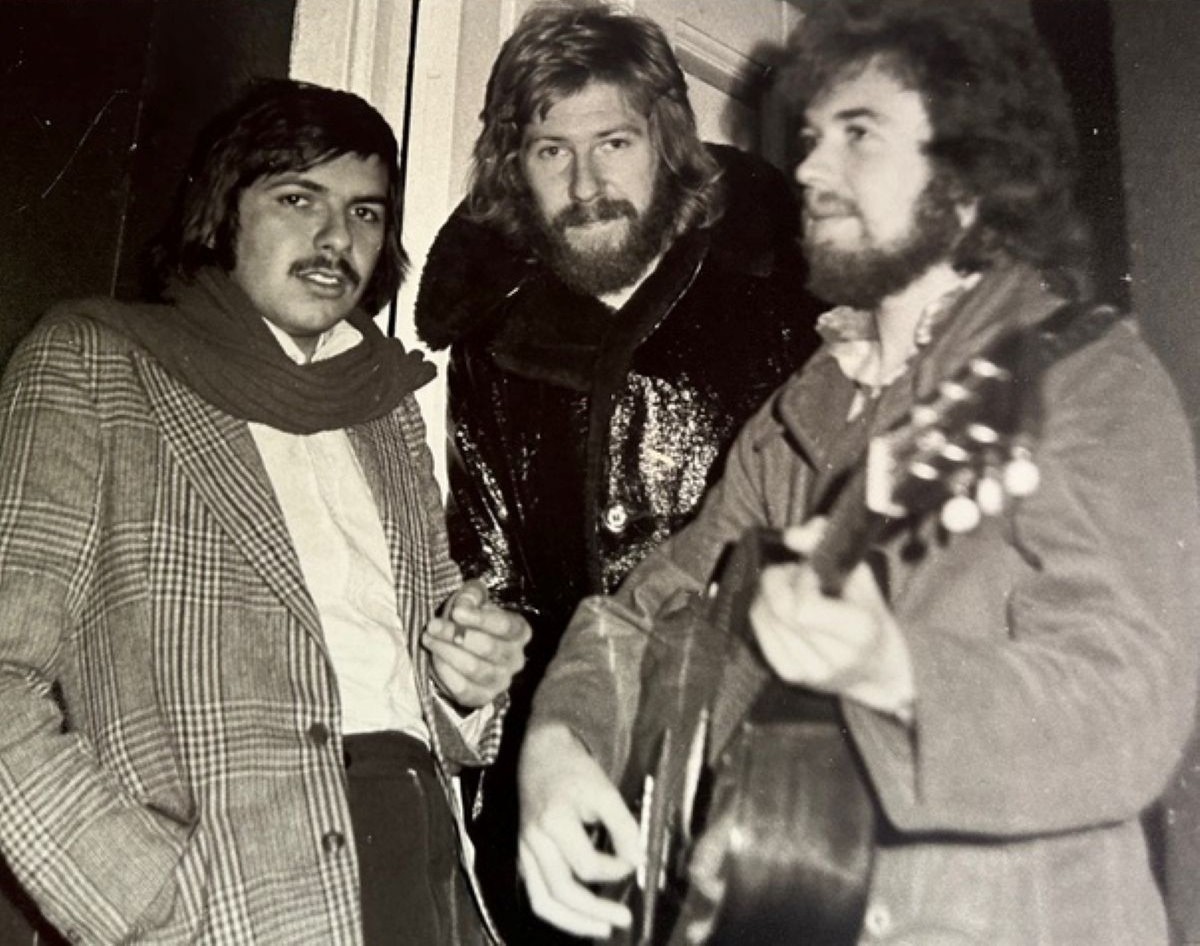
Now this was the late 60s, and bands had names that suited the period. There was Pentangle, for example. Wow man! Ace of Wands. Groovy. And we were called Ethos. Like … wild! I wore a kaftan, and sometimes a bell. Honestly, bells were a thing. We actually got some good gigs, we had a manager who, foolishly, thought we might be successful, and we acquired a roadie called Mick, a big bloke who had a van – a proper van! Now life is fine if it’s just you and a guitar, but if you’re doing okay and acquiring bigger and better equipment, then you need transport and a van felt like big time!
It also helped that Mick was a big bloke, because generally wherever you played, the promoter would say it had been a disappointing night and offer less than the fee you’d agreed. So we’d hide in the van with our artistic temperaments, knowing that Mick would emerge with the money. Ethos gave me one of the few memorable moments of my life in music – well, one at least worth passing on. We used to do a mixture of my originals (why did she dump me? Why won’t she shag me? It didn’t change much), and what weren’t then called covers of other people’s songs. Paul Simon was very big on the English folk scene at the time as a solo act, and was very much revered … as well as resented … fuckin’ Americans, coming over here, being better than we are. He had a solo album – nobody else had an album. What a bastard! One night we were playing at a club called Les Cousins, which was meant to be pronounced the French way, but was known to everyone as Les Cousins – and I was singing one of his songs, The Side of a Hill.
I was giving it all the sincerity, when Paul Simon walked in, chatting with another bloke. He sat down at a table just underneath the stage, and they kept chatting away. At the end of the song he got up to continue his conversation at the bar! He talked through the rest of our set, left as we were getting our applause, and never looked at us! So I’m afraid Paul Simon is dead to me. And I’m sure he has regretted his rudeness every day since. Bastard!
After that the drummer, who was an accountant, decided he needed more regular hours, so the
bass player introduced me to a friend from his Jewish Lads Brigade days in north London, who played keyboards. He was called Maurice Gran. We became more poppy and less folkie. Our manager called us Spoon because we reminded him of a knife, a fork and a spoon, which we could never work out. But we were the only cutlery-based band around. Unlike Ethos we combined Spoon with day jobs, but there was always that dream. And it felt like coming true when we did a gig with a singer and songwriter called Labi Siffre, who wrote a beautiful song that has really lasted called Something Inside So Strong. We got on really well, and he was very big at the time, so when he asked if we’d go on tour with him as his support band, it was an incredible opportunity.
But the bass player was just about to get married, the keyboard player was just about to get married, and I was in a relationship heading towards marriage. My now ex-wife was all for it, but she was and is quite unconventional. She worked for an aid agency and went to lots of dangerous places, and she gave me a very useful tip – always sit at the back of a cafe, because if you’re outside or at the front, the drive-by shooting will always get you. The other two – also ex-wives as it happens – were completely against it.
The most memorable night for me with Spoon was when we had been doing a gig in Essex and got an urgent message that our manager wanted us to go to the Pickwick Club in Leicester Square for double our usual rate because their resident band had cancelled. We were young (-ish), we didn’t need a lot of sleep, it was a famous club, so off we went on quite a long journey. They were thrilled to see us. There had been no music all night. The punters were restless. It was all red plush and not our usual habitat. We set up as quickly as we could, launched into our first number … and then a very drunk man invaded the stage. He wasn’t threatening, just very pissed. And he wanted to sing Irish songs.
So while the other two sat it out, the drunk and I, playing and singing along, ran through what seemed like an eternity of songs until he gracefully slid to the floor and was carried away. It was quite a sensation, and rather killed the atmosphere. But the manager said he’d pay us and thank you very much, which was great. It turned out that the drunk was a comedy writer called Johnny Speight, who created a show called Till Death Us Do Part and a character called Alf Garnett, who was and is an archetypal right-wing racist. This is the song that defeated Johnny Speight:
Well in the merry month of May from me home I started
Kissed the girls of Tuam and left them broken-hearted
Saluted father dear, kissed me darling mother
Drank a pint of beer me grief and tears to smother
Then off to reap the corn, leave where I was born
Cut a stout blackthorn to banish ghosts and goblins
A brand new pair of brogues, rattling over the bogs
Frightening all the dogs on the rocky road to Dublin
One two three four five
Hunt the Hare and turn her down the rocky road
And all the way to Dublin, Whack fol lol le dah!
What was rather odd about that, was that the bass player – Laurence – and the keyboard player – Maurice, began to write comedy themselves. Perhaps they were inhabited by the Spirit of Speight. They wrote a sitcom called Holding the Fort, a comedy-drama called Shine on Harvey Moon, and
then created their first big hit, Birds of a Feather. Now, apart from naked women and music, my
third 14-year-old obsession was television. We didn’t have a television in Ireland, so when my mum got one in London I watched everything from kids’ shows to Maigret and particularly Armchair Theatre – proper dramas. I may have been too young to appreciate the nuances, but if I couldn’t be a pop star, then I wanted to be a TV drama director.
****
With thanks to Micheál Jacob, who also supplied the photographs.
‘Life in Progress’ photograph by Craige Barker.
Felt book by Liesbeth Wieberdink.


Leave a Reply